
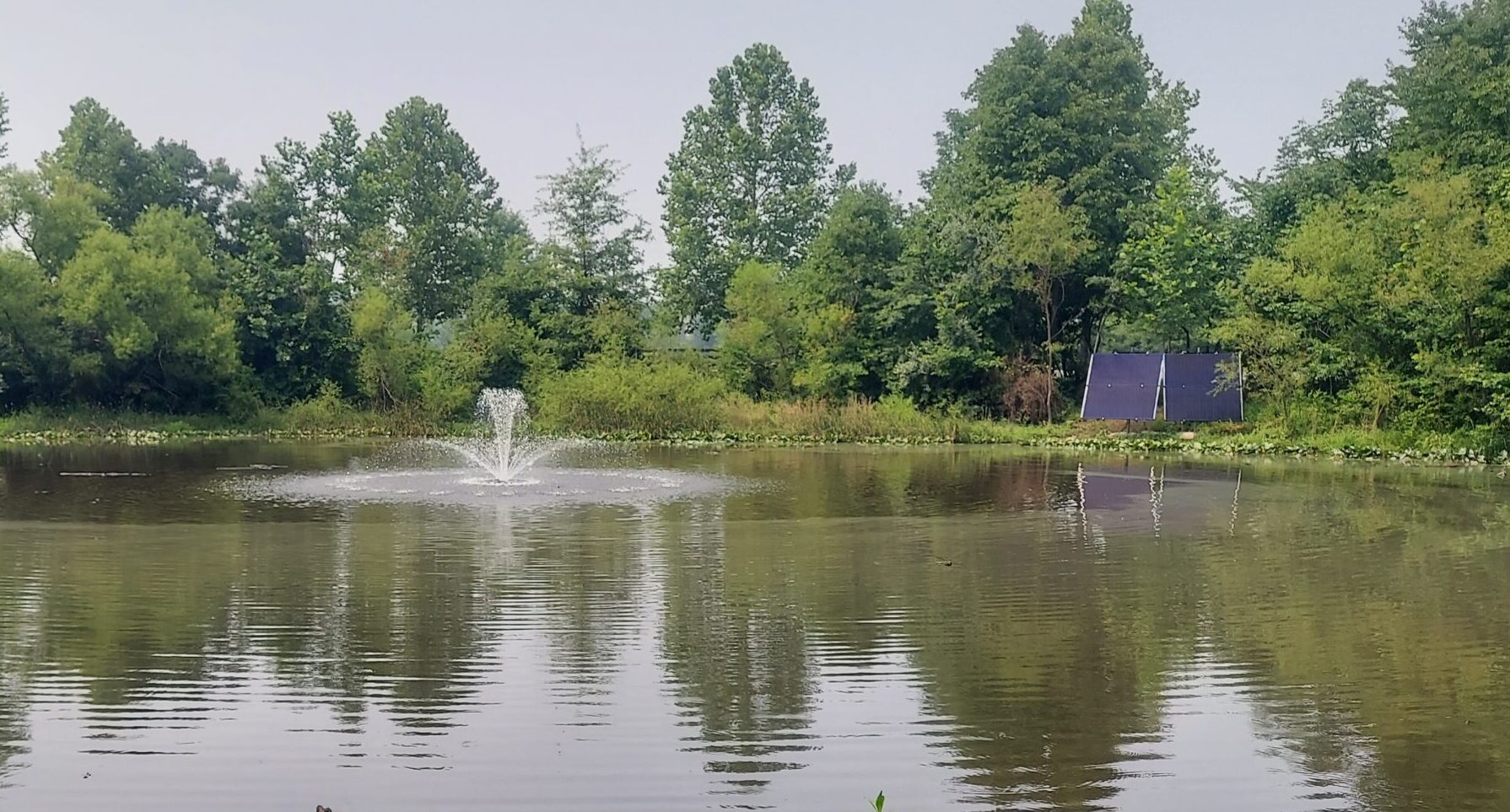
If you’ve walked by Lotus Pond recently, you may have noticed the addition of a solar-powered aeration system. While it might resemble a decorative fountain, it’s actually one piece of a larger effort to restore one of Willowsford’s oldest ponds.
Why Ponds Need Restoring
Ponds, like all living systems, have a natural life cycle. When a pond is young, it’s more or less an empty puddle of water, with few nutrients or aquatic organisms. Over time, runoff and organic material (such as fallen leaves) add nutrients, which encourages the growth of aquatic life. In a mature, healthy pond, nutrient inputs, aquatic life, and decomposition rates are all in balance and the ecosystem is a diverse haven for wildlife.
However, as a pond ages, sediment and organic matter (or muck) accumulates to the point where it overwhelms natural processes of decay, filling the pond and shifting decomposition and nutrient dynamics. As a result, ponds eventually become nutrient-rich bogs, and one day return fully to dry land. This is the completion of a pond’s natural life cycle.
However, there are ways to prolong a pond’s life, to restore it to its prime so that wildlife and people can continue enjoying its waters for years to come.
Lotus Pond’s Condition
At over 70 years old, Lotus Pond is an elder in our community and shows textbook signs of aging: shallow waters due to muck accumulation, excessive vegetation/algae, low dissolved oxygen levels, and high nutrient levels.
Restoration is focused on four fronts:
1. Limiting Nutrients
Excess nutrients (especially nitrogen and phosphorus) trigger explosions of aquatic life. Though this sounds like a glorious thing, that explosion of life eventually dies off and sinks to the bottom of the pond, where it can overwhelm decomposing bacteria, resulting in slowed decomposition rates and increased muck accumulation.
Lotus Pond is fed primarily by stormwater runoff from the surrounding neighborhood, which continually carries excess nutrients from lawns and the road into the pond, resulting in nutrient-loaded waters.
How residents can help: The most impactful step in restoring Lotus Pond is limiting the nutrients being carried into the system. Residents can help by limiting fertilizer applications to their lawns and gardens or using phosphorus-free fertilizers, identified by a “0” as the middle number in the NPK ratio (e.g., 15-0-15 or 24-0-11).
2. Vegetation Control
Aquatic plants provide shade, shelter, habitat, and food for many organisms. They’re an important part of a healthy pond ecosystem. However, excessive vegetation can dominate a pond’s surface, blocking the oxygenation of water from the atmosphere and blocking light from reaching other organisms (most notably planktonic algae that form the base of the pond’s food web). In severe cases, this can kill virtually all other organisms in a pond.
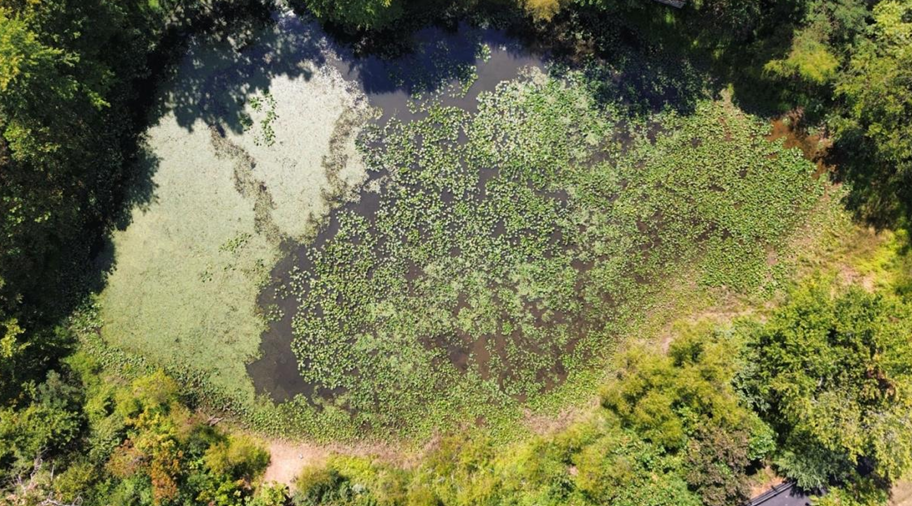
Last year, approximately 95% of Lotus Pond was covered in watershield and spatterdock. Both of these plants are native and beneficial to pond ecology when present in moderation, but detrimental when dominating surface waters to the degree they were.
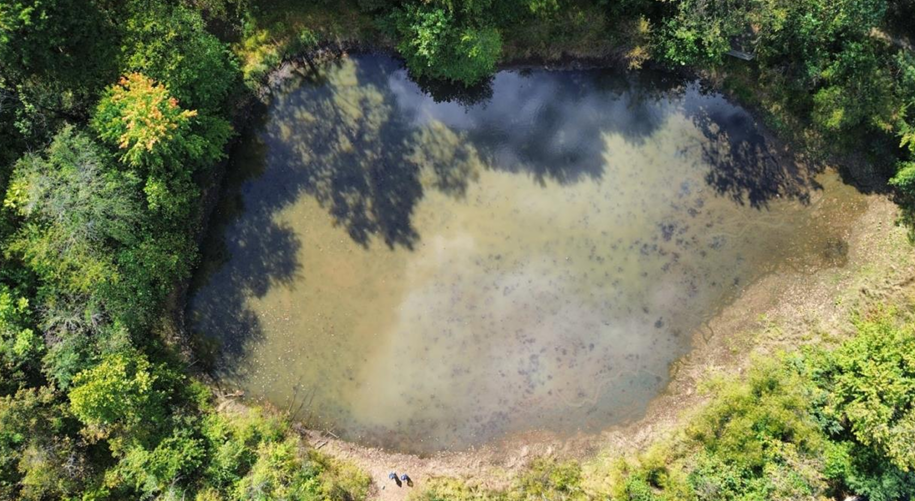
Lotus Pond was treated in September of 2025 to cut vegetation levels back to a balanced state, which they remain at today. Reducing nutrient loads and deepening the pond via dredging will help to prevent vegetation from reclaiming the pond’s surface as aquatic vegetation thrives in nutrient-rich, shallow waters.
3. Aeration
Aquatic life suffers when dissolved oxygen levels are low, and so does decomposition. Aerobic bacteria consume oxygen as they decompose organic matter and return it to usable nutrients. As organic matter accumulates, decomposition demand rises, and the bacteria consume more and more dissolved oxygen until the oxygen in the pond is depleted. At this point, anaerobic bacteria are left to take over the role of decomposition. However, they work up to 20 times slower than aerobic bacteria and often produce toxic byproducts, such as methane and ammonia. This leaves the pond with low dissolved oxygen levels, an increasing muck accumulation rate, and higher loads of toxic nutrients. This in turn leads to mortality events for aquatic life, which increases decomposition demand and feeds into the negative cycle.
Water quality testing done around the time of the aerator installation showed Lotus Pond had dissolved oxygen levels of 1.37 mg/L and ammonia levels of 3.25 mg/L, these values are in critical range and will lead to mass mortalities if not addressed swiftly. These findings reinforced the Conservancy’s decision to install a solar-powered aeration system as a long-term, sustainable restoration strategy.
Three weeks after the addition of the aerator, dissolved oxygen levels have risen to 5.9 mg/L and ammonia levels have dropped to 0.5 mg/L, both are in acceptable range and hopefully improving! The installation of the aerator has pulled Lotus Pond out of critical condition and will continue to support aquatic life and naturally occurring aerobic bacteria that more efficiently break down accumulated organic matter, increasing decomposition rates and reducing toxic nutrients in the water column.
4. Dredging
Like all aging ponds, Lotus Pond has decades of organic matter accumulation. If you take three steps into the pond, you’ll find yourself buried hip deep in muck!
Decades of accumulated muck can’t be resolved by aeration alone. To restore Lotus Pond to a healthy, sustainable state, some form of dredging must be performed. Dredging is the removal of muck from a pond, and it typically comes in two forms:
- Mechanical dredging: physically removes sediment and muck
- Pros: quick (done in a matter of days or weeks)
- Cons: disruptive to the ecosystem, costly
- Biological dredging: introduces bacteria/enzymes to speed up natural decomposition
- Pros: cheaper, less disruptive
- Cons: takes 1–3 seasons, doesn’t remove sediment
The Land Stewardship Team is currently evaluating which approach to dredging makes the most sense for Lotus Pond.
What’s Next for Lotus Pond
Pond restoration is gradual, with improvements unfolding over multiple seasons rather than overnight. The Conservancy will continue monitoring Lotus Pond’s water quality, finalize a dredging plan, and pursue further stewardship steps as needed.
Protecting natural resources like Lotus Pond remains central to the Conservancy’s mission. The installation of the solar-powered aeration system is one more step toward ensuring that Lotus Pond remains a healthy, resilient ecosystem for wildlife and a valued natural amenity for the Willowsford community for years to come.
We’d Love to Hear from You
We’d love to know what you’ve observed around the pond. Have you spotted fish, frogs, turtles, dragonflies, birds, or other wildlife during your visits? Did you witness a large algae bloom after a storm event or dramatic changes in water levels?
Your observations and memories help us better understand how Lotus Pond has changed over time and support our ongoing stewardship of this special natural area. Feel free to share your experiences and photos with us at info@willowsfordconservancy.org!