
Take a moment to close your eyes and picture a pond, a stream, a stretch of river. Think of everything within these ecosystems, the organisms that belong to them. Now ask yourself: where did your mental image end? For most people, it ends at the waterline, a clean break between water and land.
These ecosystems extend beyond their banks and are deeply interwoven with the surrounding landscape. In fact, the strip of land where water meets earth isn’t a boundary at all, it’s a bridge. Ecologists call this kind of zone an ecotone, a transitional place where two ecological communities overlap and interact. Not fully aquatic, not fully terrestrial, but a blend of both and often more biodiverse than either side alone. This is the riparian buffer.
Composition of a Riparian Buffer
Riparian buffers are vegetated areas alongside water bodies, such as streams, rivers, lakes, ponds or wetlands. They vary in size and vegetation type, but the general rule of thumb is the wider and more diverse the buffer, the greater the benefits. Healthy buffers are rarely just grass; they’re layers of native trees, shrubs, grasses, and wildflowers, each playing a distinct role. Forested buffers are considered especially strong due to the stabilizing nature of tree roots, the shade provided by forest canopy, and the habitat and food woody material provides to aquatic organisms.
More Than a Buffer
When rain falls, it flows across roads, lawns, open spaces, and developed areas before reaching nearby water bodies, picking up sediment, excess nutrients, and other pollutants along the way. Riparian buffers are famous for filtering this runoff before it reaches the water. However, they do far more than serve as a simple buffer. Riparian zones provide many ecosystem services, including:
- Sediment Trapping – Vegetation slows runoff, letting sediment settle out in the buffer instead of the water body. This maintains water clarity and light penetration, slows the infilling of ponds and streams, and protects aquatic habitat from being smothered. Too much fine sediment can be especially damaging to fish as it clogs their gills.
- Nutrient Filtration & Pollutant Breakdown – Runoff from development and agriculture carries excess nutrients and pollutants that fuel algal blooms and the oxygen depletion that follows. Riparian buffers can remove up to 80 percent of excess nutrients through plant uptake and bacterial degradation, and microbial communities can break down certain pollutants into less toxic forms before they ever reach the water.
- Groundwater Recharge – By slowing surface runoff, buffers give water time to infiltrate the soil and recharge groundwater, helping control flooding while also safeguarding against drought.
- Wildlife Corridor Establishment – Riparian buffers provide continuous green corridors through otherwise fragmented landscapes, letting animals move safely between habitat patches.
- Habitat – Dense, diverse vegetation offers food, shelter, and nesting sites for birds, amphibians, and small mammals.
- Food Supply – Leaf litter and woody debris falling from riparian vegetation provide the main food source for aquatic invertebrates, especially in small streams with limited aquatic plant growth. These aquatic invertebrates form the base of food chains that run all the way up to fish, as well as birds and bats when they emerge from water bodies as flying adults. Thus, the presence or absence of riparian vegetation ripples through the food web and changes the species composition of entire water bodies. Additionally, the plant composition of a buffer matters as much as whether a buffer exists at all. Native vegetation evolved alongside the aquatic organisms that depend on it, producing leaf litter that breaks down at the right time, at the right rate, with the right nutrient content to sustain the food web. Invasive species disrupt that balance. Their leaves decompose on a different timeline and carry a different nutritional profile, which throws the whole system out of sync and decreases biologic productivity.
- Erosion Control – Root systems physically bind soil, reducing bank collapse and channel widening during high-flow events.
- Flood Mitigation – Vegetated buffers slow and spread out floodwaters, reducing peak flow velocity and downstream flood risk.
- Temperature Regulation – Higher stream temperatures reduce water’s oxygen carrying capacity, encourage algae and bacteria growth, and increase the release of nutrients from sediment and their toxicity. Shade from tree canopies and transpiration from riparian plants keep stream temperatures cooler and more stable.
- Carbon Sequestration – Riparian trees and soils store carbon, and the high productivity of these zones makes them especially efficient at it.
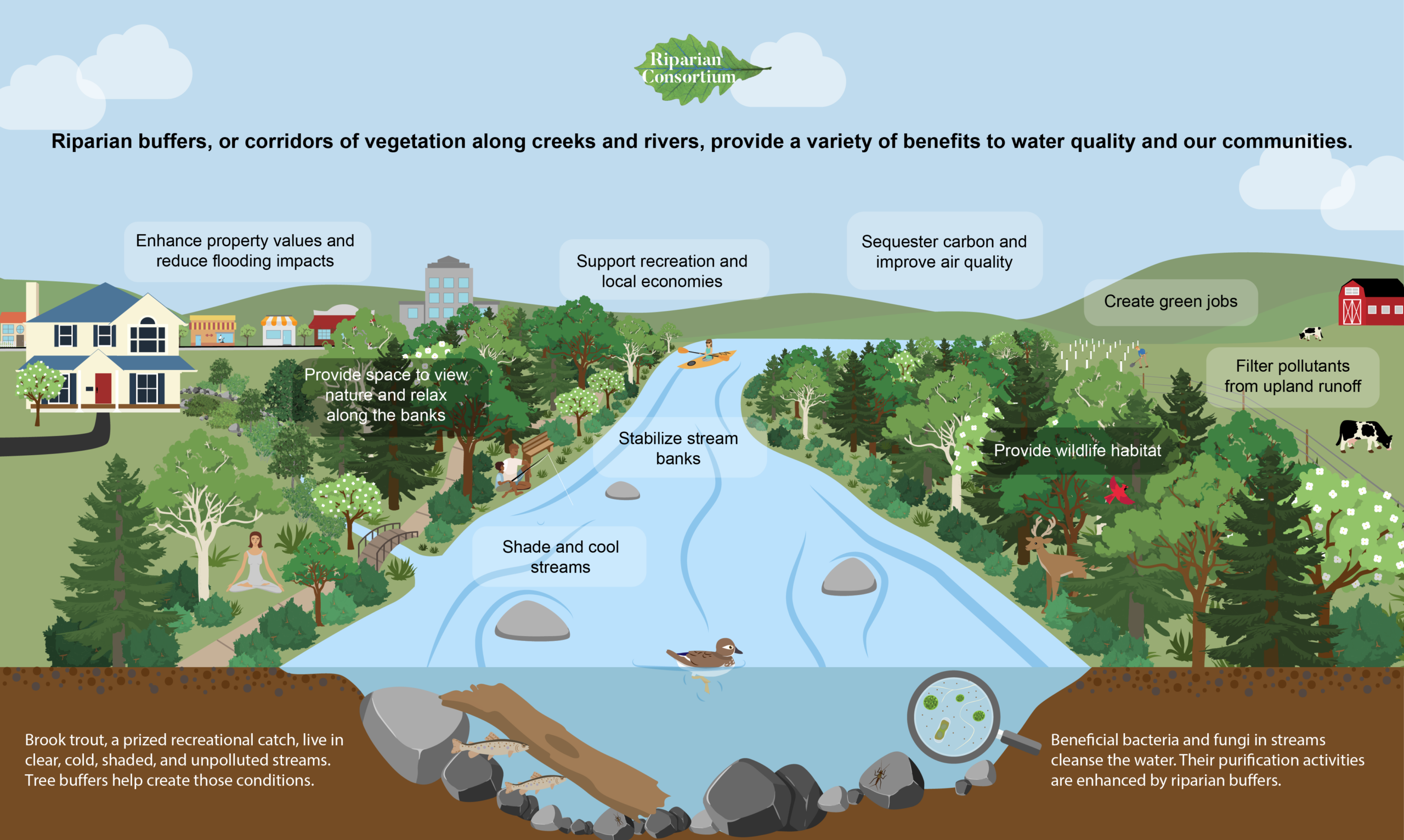
Credit: Upper & Middle James River Consortium
Our Work at Willowsford
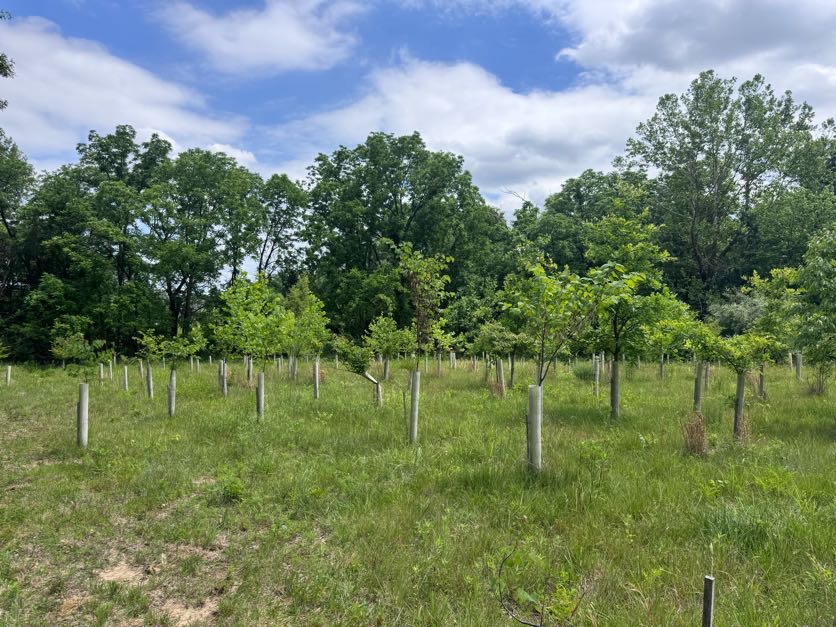
Protecting and restoring riparian buffers is central to the Conservancy’s long-term land stewardship efforts. Since 2016, we’ve restored approximately 5.3 acres of riparian buffer, planted more than 3,066 native trees and shrubs, and leveraged over $48,372 in grant funding. Much of this has been made possible through grants and technical assistance from the Loudoun Soil and Water Conservation District, partnerships that let us stretch Conservancy resources and expand our restoration efforts.
Restoration Is a Long-Term Commitment
Planting the trees is only the first step. Our Land Stewardship Team provides ongoing care to help young trees become established: maintaining planting tubes that shield seedlings from animal browse, wind, and equipment while creating a small greenhouse effect that promotes growth; cutting trees free of choking vines; mowing back competing vegetation; and treating invasive species. Many grant-funded projects also require multi-year monitoring, with annual surveys tracking tree survival and health to ensure sites continue meeting performance standards.
Beyond Our Banks
Every ditch, culvert, and stream that flows through Willowsford is part of the Chesapeake Bay watershed, which spans six states and over 64,000 square miles. This means every pound of sediment or nutrient that a local buffer intercepts is a pound that never enters the nation’s largest estuary. Multiply that across the thousands of waterways within the watershed, and the cumulative effect is enormous.
When we protect and restore a riparian buffer in Willowsford, we’re not just tending to our own community. We’re participating in a chain of connectivity that stretches from here to the Chesapeake.
So the next time you sit beside a pond or walk one of Willowsford’s streamside trails, take a moment to notice the trees growing along the water’s edge and the planting tubes that protect many of them. With continued care and stewardship, these young trees will become the next generation of streamside forests, restoring and protecting our water bodies and our watershed for decades to come.