
Spotted Lanternflies
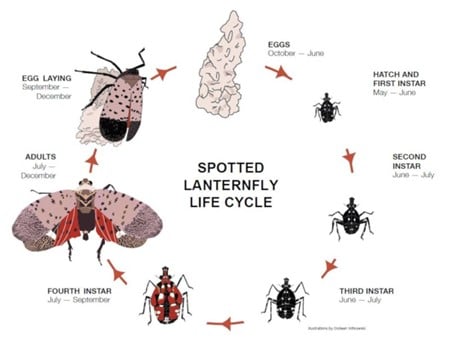 As many of you have been noticing, the spotted lanternfly (Lycorma delicatula) has been increasing in numbers here at Willowsford. Also known as SLF, the spotted lanternfly is native to China and parts of Vietnam where its populations are kept under control since it is eaten by parasitic wasps. But, in the U.S., spotted lanternflies are considered invasive and cause damage to grape vines, apples, stone fruits, and various trees.
First brought to the US via Pennsylvania more than 10 years ago, the pest has been spreading to more and more states. They first made their appearance in Loudoun County a few years ago and, unfortunately, they are here to stay. The Conservancy has been in close contact with the USDA, the Virginia Department of Forestry (VDOF), and our local Virginia Cooperative Extension office since the spotted lanternfly was first sighted here. We have worked with them closely to understand expectations, explore possible management practices, and stay up to speed with how the state and local governments intend to address it. Despite these efforts, the final verdict is the same as it was in Pennsylvania, Maryland, and West Virginia: the spotted lanternfly is here to stay in Virginia, and we cannot prevent it. Virginia Department of Agriculture and Consumer Services (VDACS) recently repealed their Quarantine Act back in March of 2025 and they are not able to offer any support to communities as there is very little chance of eradication of the species at this point.
Unfortunately, Willowsford Conservancy does not have the ability to keep thousands of lanternflies out of more than 4,000 acres of land in our community. Although we cannot eradicate them from our area completely, there are some steps we will be taking in our land management areas to help reduce the SLF population. And, we are committed to helping our community through the next few years of population boom and we will continue to keep residents updated.
It is important to understand what to expect for the next few years. The spotted lanternfly population will initially get significantly worse. They most likely will be present in the hundreds and thousands over the next couple years before the population starts to decline. SLF produce a sticky substance called honeydew, which attracts pollinators such as wasps to feed on the sugary substance. But the honeydew can also encourage the growth of black sooty mold, which will cover plant leaves and can stain fences and furniture. When their populations are high, it is very likely you will see bees and wasps in the area and the black mildew on low growing plants. We can also set our expectations based on the experience of Pennsylvania and other nearby states where native birds and animals are learning that they can eat SLF and the SLF discover that they like to eat native plants, like milkweed, which are toxic to them. Once natural controls take place, the populations will gradually reduce, and they will be very similar to the non-native stinkbugs and Japanese beetles we deal with currently—annoying but not overwhelming.
Homeowners can follow these actions as well to reduce the populations in their yard and around their home:
- Learn how to identify the insect in all of its stages, so the nymph stage as well as the adult insect we all recognize.
- Scrape the egg masses each spring on any trees in your yard. The Conservancy and the HOA participated in the 2025 Scrape for the Grape — the popular and successful event organized by the Loudoun Invasive Removal Alliance which is a collective group of many HOAs, including our HOA and the Conservancy. We will continue this awareness-building program.
- Squashing them whenever you see them. This can work for small infestations or the occasional SLF.
- Spraying them directly with a mixture of soapy water and distilled white vinegar can kill the bugs.
- Using organic pesticides such as Neem Oil
- Some people are finding non-toxic salt guns effective (but this tool needs to be used safely).
- Willowsford Conservancy strongly discourages the use of pesticides to kill SLF, as there are no insecticides that target SLF specifically and spraying could result in the loss of many beneficial bugs, such as pollinators, and could damage landscaping. Killing all bugs can result in a population imbalance that is a leading cause of landscaping issues in neighborhoods such as ours.
- If there is an infestation in Conservancy open space that a resident would like to address themselves, they can reach out to us at info@willowsfordconservancy.org and request to do a project in the open space.
Tree of Heaven
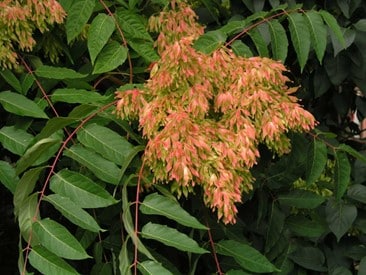 The discussion of spotted lanternflies goes hand-in-hand with the problem of the problematic and pervasive Tree of Heaven (Ailanthus altissima). Tree of Heaven (ToH) is an invasive tree that is also the prefered host tree for the spotted lanternfly. This fast-growing tree came to North America from Asia as an ornamental in the late 18th century. It grows and establishes very quickly and aggressively sprouts new trees from the root system, making it hard to truly kill. In addition to its rapid growth rate, Tree of Heaven is also allelopathic, meaning it secrets a toxic chemical the suppresses the growth of other vegetation. While Tree of Heaven is a favorite tree for SLF, and often is the host tree for their egg masses, lanternflies will be very happy feeding and nesting on maple trees, black walnuts, grape vines, and more. Strangely two of the trees that SLF also prefer are native and look like ToH! Black walnut and staghorn sumac are often mistaken for the invasive tree — watch this informative video or check out this comparison of the leaves to determine the three tree types. Check out this brochure we designed to help you identify and report ToH.
Within Willowsford, this tree is very commonly found behind resident homes or in other areas that were heavily impacted during the development of the community. ToH thrives on roadway, forest or meadow edges which give it the full sun it prefers. Some of these trees have grown to be quite big and often act as a visual screen between properties. This makes it not only a challenge to remove, but also requires us to replant an area with large trees after removal.
Killing the invasive Tree of Heaven poses several challenges to the Conservancy in particular. The most commonly used and effective way to kill ToH is by cutting down and treating with herbicide, making cuts into the trunk and applying herbicide directly, or spraying or applying herbicide to the bottom foot of the tree then waiting for the tree to die and either remove the tree or allow it to remain standing. The timing is paramount. Poisoning the trees must be done in the fall when the tree is redirecting its energy to storing nutrients in the root system, taking the poison with it and killing the plant down to the roots. If treatment is mistimed, it can trigger the tree to send up rapidly growing sprouts from the root system, turning one tree into 20 trees! It is also possible to hand pull small saplings when the soil is moist enough to ensure the entire root system is removed with the tree.
What We’re Doing
The Conservancy is actively working to address the Tree of Heaven growing in easy-to-access areas where they can be killed and either removed or left as spars which provide habitat to wildlife. However, the Conservancy is extremely limited on how many sites can be addressed behind resident homes. Addressing smaller trees which will not cause damage to private property will be easier to tackle and with planning the larger trees that would need to be removed and possibly replaced will be a longer-term priority. Treating ToH is part of our larger multi-year Invasive Species Treatment Plan.
The Conservancy plans to continue participation in the Loudoun Invasive Removal Alliance (LIRA) Scrape for the Grape event to remove egg masses each spring. We are also planning to implement a Tree of Heaven chemical treatment and tree removal program this late summer/fall (2025) and for the years to come as this will be a multi-year effort. We will augment this by applying for grant funding through a county/LIRA program that will open in the fall. We are also planning to hold one or two demonstration projects in the next couple of months where volunteers can support our control efforts (stay tuned for more information).
We will follow the best practices laid out by the state, Loudoun County and LIRA which include 1) identifying the tree and mapping out all the locations in our community and then 2) determining the best treatment method depending on the size and location of the trees. The cut stump method, hack and squirt method, and basal bark spray methods will be evaluated for each priority treatment area. It is important to note that when large Tree of Heaven are treated, they need to be removed if they are near a trail or home.
With the amount of Tree of Heaven in the community, it will be extremely difficult to treat and/or remove every tree from the open space due to access, safety, logistical issues, and the size of some of the mature stands, but we are committed to a comprehensive plan. It is important to note that removing Tree of Heaven may help curb the population locally, but it will not eliminate Spotted Lanternflies entirely due to their expanded host range.
How You Can Help
Help us identify Tree of Heaven (ToH) stands by surveying the open space behind your home! To best determine whether it is the invasive ToH or one of the two beneficial native trees that often resembles ToH (black walnut and staghorn sumac), we recommend this handy leaf comparison or video diving into the bark, leaves, fruit of all three trees. Fill out information here with your address, images, approx. number of ToH, and range of diameters of the tree trunks (this is because different control methods are used based on the size of the Tree of Heaven). This will help us fill in the hard-to-access open spaces in our mapping system and will inform our multi-year invasive species removal project.

Report Tree of Heaven here.
Residents can also pursue an Open Space Project where they work alongside the Conservancy and through a signed agreement carry out invasive tree removal through contractors on behalf of the Conservancy. Many neighbors in our community are contributing time and resources to help remove and replace invasive plants in the Open Space behind their homes. In some cases, the Conservancy can assist with cost-sharing to help residents complete an invasive plant removal or restoration project. With such limited time and resources within the Conservancy, we value working with Willowsford residents who embrace our mission alongside us. For more information on how to get involved, reach out to us via our contact form or read more on Open Space Projects section on our website.
Thank you for your attention and assistance in tackling these invasive challenges.