
This summer, our land management team was joined by an intern, Hailey Tritten, who spent weeks exploring Willowsford’s meadows and grasslands, collecting valuable data through vegetative surveys. These surveys play a critical role in tracking the health of our ecosystems, identifying native and invasive plant species, and informing future restoration efforts. Read about how and why we do these vegetative survey’s below:
 Q: What is a vegetative survey and why is it important?
A: A Vegetative Survey is done to collect data on various species of plants and their concentration in an area. Vegetative surveys are important because it allows us to better understand the biodiversity of the land. The amount of native plants can indicate the overall health and productivity of an area. Vegetative surveys also give more insight into which invasive plant species are beginning to establish. With this information we can form a plan to start treating the invasives and allow more natives to move in.
Q: How do you do a vegetative survey?
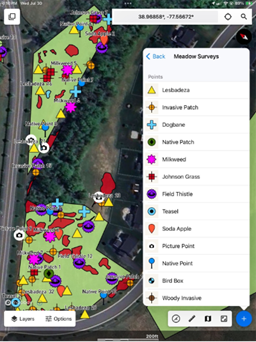
A: I use a mapping software called TouchGIS on a tablet. I walk through meadows and identify any patches of grasses or plants and add a point to the map. In the description of the point, I describe the diameter of the patch, concentration of the plant and any other plants that are encroaching. For any patches larger than 15ft I use the GPS function and walk around the patch. This creates a more accurate map overview. Throughout the meadow I will take pictures and add those to the map as well. This can be helpful later to assess not only the concentration of various plants but also to see the general health of them. Lastly, I will write an overview of the meadow describing what grass is carpeting the meadow, the highest concentration of species and what invasive to look out for.
Q: How many meadows/grasslands did you survey this summer?
A: I completed 40 meadow surveys in 5 weeks and my goal is to complete another 20 before leaving, weather permitting!
 Q: How will the vegetative survey help inform our future work restoring our meadows?
A: The surveys done this summer will be referred to in the following years to see how the concentration of invasive species has changed after treatment. With this information we will be able to better understand how well our invasive treatments are working and the timeline for controlling invasives.
Q: What was the most interesting thing you found as part of the vegetative survey?
A: I found it interesting how much the terrains of the meadows could vary in one village. One meadow may be very wet and would have plants that like those conditions like swamp milkweed, soft rush and Joe Pye weed. Walking distance from a meadow like this there may be a meadow with completely different land conditions and plant compositions. I thought it was cool to see how even in a small area how much diversity there is.