
The fall macroinvertebrate monitoring season is wrapping up and we’re here to share the process and shine a spotlight on some of the little-known water quality warriors we have here at Willowsford.
What Are Benthic Macroinvertebrates?
Benthic (“bottom-dwelling”) macroinvertebrates are the little critters that lack a backbone, can be seen without a microscope, and call the bottoms of streams, rivers, lakes, and ponds home.
Insects are the most abundant group of macroinvertebrates. They live underwater as nymphs or larvae for months to years, then emerge as adults, often living on land just long enough to reproduce. Common aquatic insects include dragonflies, caddisflies, stoneflies, mayflies, beetles, and midges. Other macroinvertebrates, such as crayfish, snails, mussels, and aquatic worms, never leave their underwater homes.
These little guys turn up in every aquatic ecosystem, even the most inhospitable, and they fill critical roles:
- Primary consumers that feed on live organic material like algae and aquatic plants
- Detritivores that break down leaves and woody debris and recycle nutrients
- Predators that feed on other invertebrates
- Prey for fish, amphibians, reptiles, aquatic birds, and mammals
Why Do We Monitor Them?
Macroinvertebrates live in all water bodies, but their abundance and diversity vary according to natural factors such as geographic location, season, temperature, elevation, and riparian habitat. Community composition will also shift in response to pollution and other human-caused stressors. Because each organism is adapted to different conditions and has its own stress/disturbance tolerance levels, those present can tell us a lot about a water body, its health, and the stressors at play.
Using living organisms to gauge the quality of their environment is called a bioassessment, and macroinvertebrates are among the most widely used organisms for it. Here’s why:
- They’re easy to sample and identify
- They’re present in most water bodies
- They have limited mobility, leaving them unable to escape stressors
- They’re sensitive, with different organisms responding to different types and levels of disturbance
- Their long life cycles reflect water quality over time, not just on a given sampling day
- They’re a critical link in the food web, with changes in their communities rippling through ecosystems
Bioassessments vs. Chemical Tests
When people think of water quality testing, they tend to think of chemical tests and are often unaware of bioassessments. Bioassessments and chemical tests each have their uses.
Macroinvertebrate Bioassessments |
Chemical Tests |
|
|---|---|---|
Time Scale |
A long-term indicator of water quality | A snapshot of a single moment |
What It Measures |
Overall ecosystem health | Concentrations of specific pollutants |
Blind Spots |
May not pinpoint the exact pollutant, since some macroinvertebrates are sensitive to several | Can’t detect pollutants you didn’t test for and may miss stressors like sedimentation |
Ecosystem Insight |
Reflects how biological communities are responding to stressors | Offers little insight into complex ecosystem dynamics |
The takeaway: Bioassessments are an effective way to get a comprehensive measure of the long-term health of a water body. When a site turns out to be degraded, chemical testing can help further track down the culprit
What Can Macroinvertebrates Tell Us?
Healthy water bodies generally support a diverse community of macroinvertebrates. A sample with very little diversity, low abundance of macroinvertebrates, or one dominated by pollution-tolerant species may point to a degraded water body.
The tolerances and diversity of the species present indicate overall water quality. Their habitat preferences, movement, feeding patterns, and breathing structures go further, offering clues about specific conditions and likely stressors.
Keep in mind, not every change means trouble. Season, temperature, and other natural factors affect macroinvertebrate communities, so the presence or absence of an organism may simply reflect normal population swings. Monitors must understand these natural influences or follow established protocols that account for them.
Creature Features
Flatheaded Mayfly (Maccaffertium)
Stress tolerance: Sensitive
Habitat: Most species live on rocks or woody debris in cool, fast-moving streams.
Movement: Clinger – flat bodies and hooked feet allow them to hold tight to rocks and debris in fast currents.
Feeding: Scraper – they graze on algae growing on rocks and other surfaces.
Breathing: They have gills along their abdomen that flutter to circulate oxygenated water in low oxygen conditions. Their delicate gills are easily damaged or smothered by sand and silt.
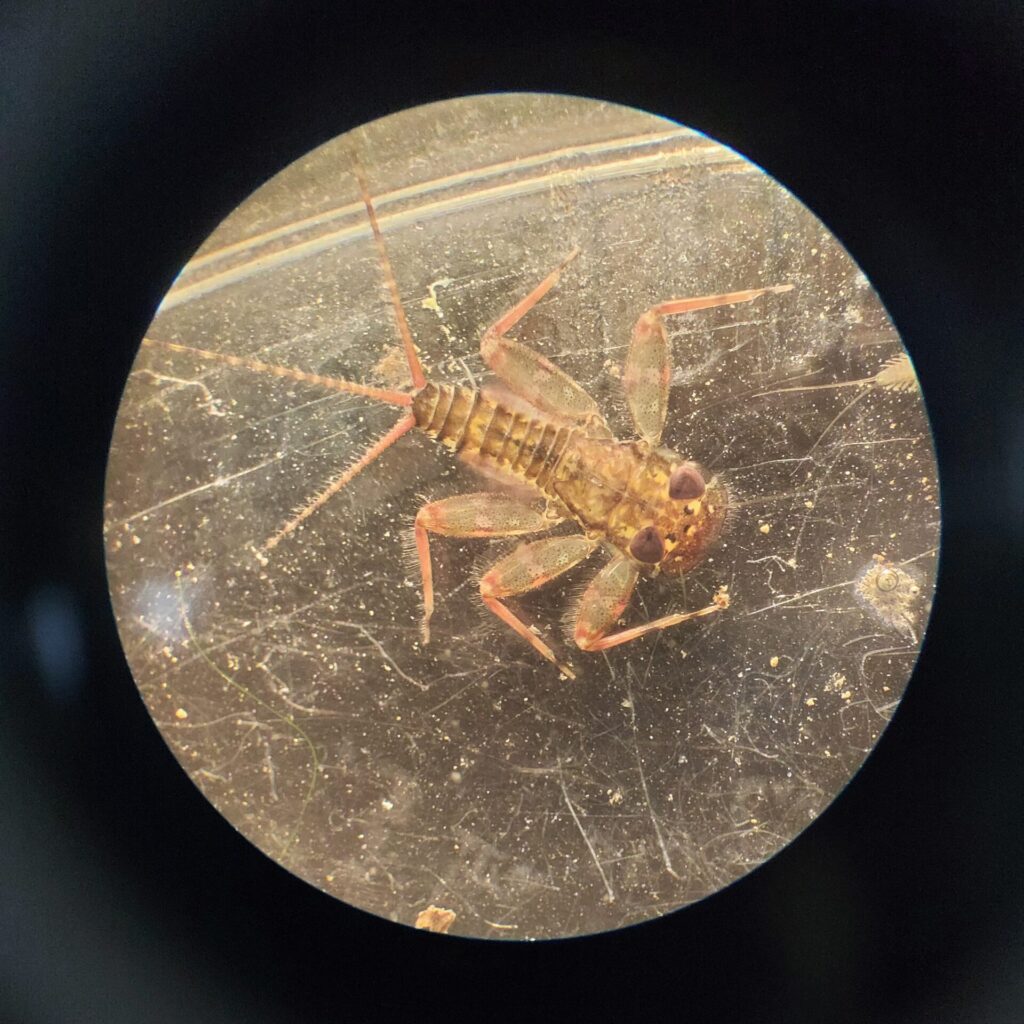
What they Tell us: Mayflies (order Ephemeroptera) are one of the primary pollution-sensitive gropus. Together with stoneflies (Plecoptera) and caddisflies (Trichoptera), they form the “EPT” taxa that most bioassessments look for as a sign of good water quality. Many kinds of mayflies, or large numbers of them, are a reliable indicator of high levels of dissolved oxygen and minimal pollutants and disturbance. Losing diversity over time, or finding fewer than expected compared to reference sites or past samples, is a sign of degradation. If they are absent altogether, the water body may be degraded to the point that it cannot support sensitive species. This is often due to sedimentation or pollutants.
Clubtail Dragonfly (Ophiogomphus)
Stress tolerance: Less sensitive
Habitat: Unlike most dragonflies and damselflies, which prefer still water, clubtails are commonly found in flowing water. They live in sand, silt, and other soft substrates, and can be found in the little pockets of sediment between rocks.
Movement: Burrower – curving their body upward in a backbend, they cover themselves with sediment, leaving only their eyes and the tip of their abdomen uncovered.
Feeding: Engulfer-predator – they lie in wait beneath the sediment and grab prey that wanders too close.
Breathing: Their gills sit in an internal chamber in their abdomen that they pump water in and out of. This keeps water flowing over the gills while protecting them from coarse sediment. They keep their abdomen uncovered when burrowing, using it like a snorkel.
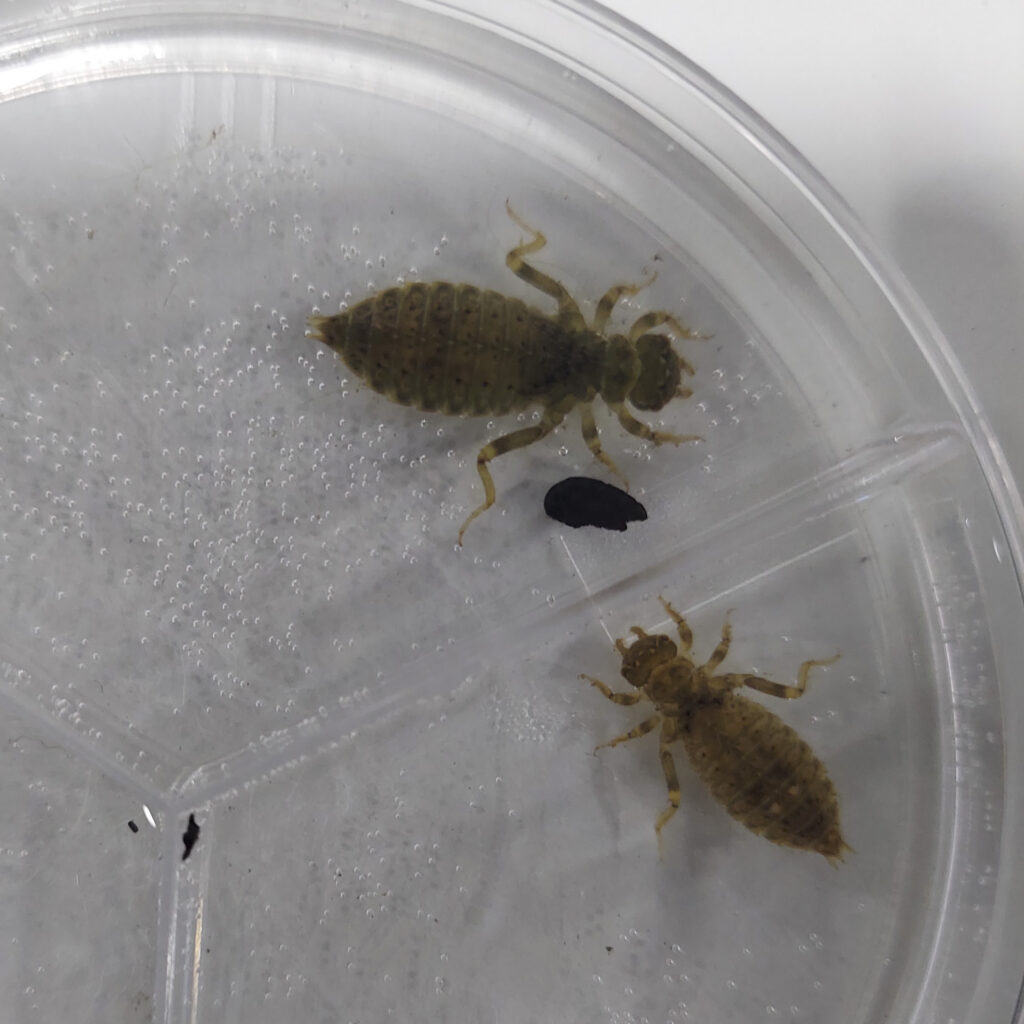
What they tell us: Clubtails can tolerate more sedimentation than mayflies because their gills are protected, but they are still somewhat sensitive to disturbance and pollutants and if their prey is impacted, so are they. If clubtails and other less sensitive organisms dominate a sample and sensitive organisms are scarce, some disturbance or pollution has likely occurred. Because they are predators, dragonflies are rarely found in great numbers, so even a few individuals are a meaningful find.
Non-Biting Midge (Chironomus)
Stress tolerance: Tolerant
Habitat: Soft, muddy sediments.
Movement: Burrower – they build tubes out of fine sand and silt bound with silk. The tubes are open at both ends, and the midges wiggle to keep oxygenated water flowing through.
Feeding: Collector-filterer – they eat organic matter in the sediment around them and fine particles suspended in the water.
Breathing: Midges breathe through their skin. Hemoglobin in their blood binds oxygen even at very low concentrations, enabling them to survive lower oxygen conditions than other macroinvertebrates.

What they tell us: Midges are often the most abundant group in any stream, so their presence alone is not a concern. However, high counts of red, hemoglobin-carrying midges likely indicate pollution from organic waste, such as sewage and fertilizer, and low dissolved oxygen conditions.
Willowsford Biomonitoring
Willowsford currently has two stream sites where macroinvertebrate bioassessments are conducted, with plans to establish more in 2027. The current sites were established through Loudoun Wildlife Conservancy’s (LWC) Stream Monitoring program. Today, the sites are monitored by Willowsford residents and the Land Stewardship Team, all of whom are certified through LWC.
Huge thanks to the hardworking members of LWC and the dedicated volunteers who established these sites and have been monitoring Willowsford’s streams for years!
Monitoring Methods
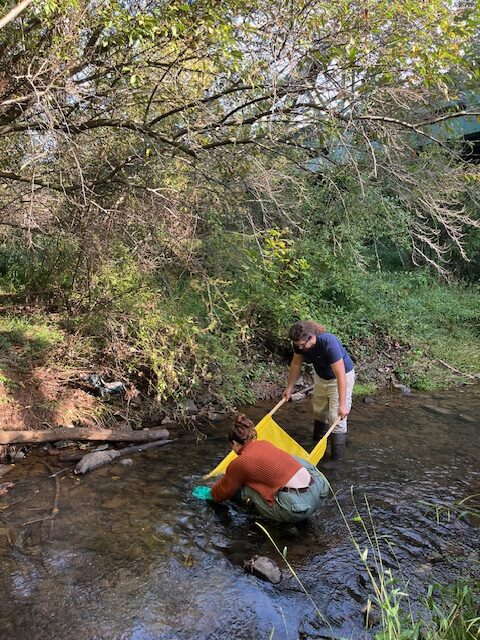
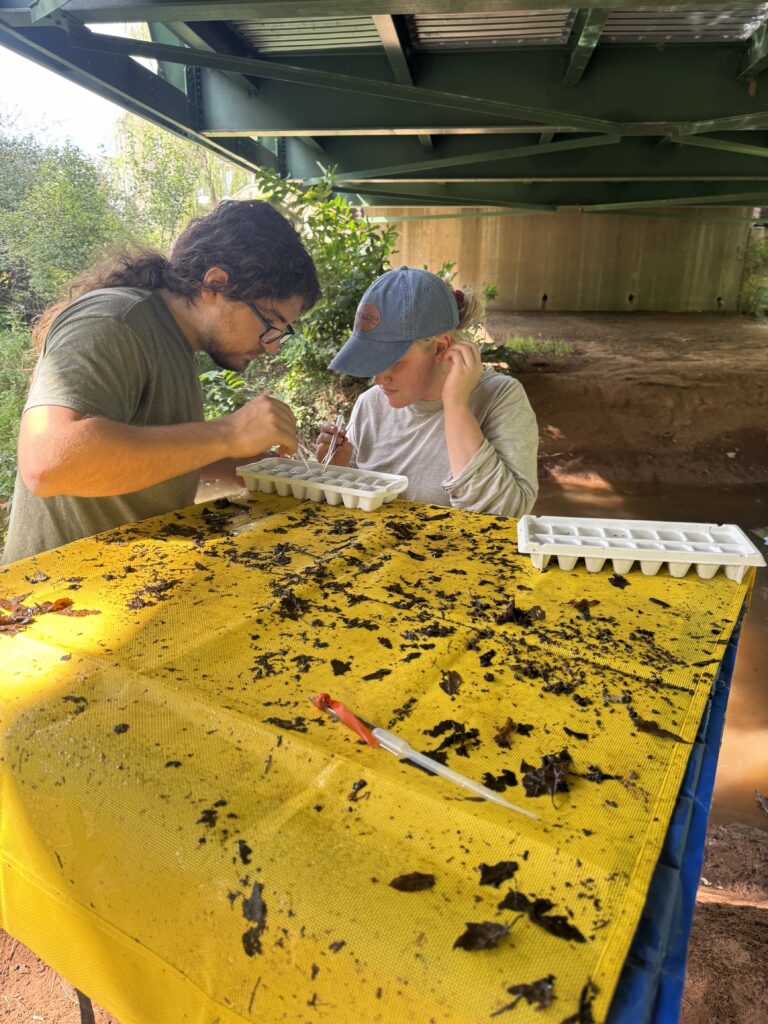
The bioassessments follow the protocol of Virginia Save Our Streams (VA SOS), an Izaak Walton League of America program, and are conducted twice a year, in spring and fall. This schedule provides a good picture of stream health while limiting disturbance to the stream.
- Collect a sample with nets.
- Sort and identify the organisms.
- Score the stream. Individual metrics, such as the number of pollution-tolerant species and the number of non-insects, are combined into a multimetric index score that ranges from 1 (unacceptable ecological condition) to 12 (acceptable).
All data is submitted to VA SOS, which submits it to the Virginia Department of Environmental Quality. The data is then used to identify impaired streams and allocate resources for further monitoring, conservation, and habitat restoration.
Willowsford Stream Scores
All Willowsford macroinvertebrate bioassessment data is uploaded to the Clean Water Hub, where anyone can view the environmental and chemical data for stream sites included in the network. Follow the links below and click over to the “VA SOS/CMC Rocky Bottom” tab to see past macroinvertebrate stream scores. You can also click on individual surveys to see exact macroinvertebrate counts!
| Stream | Station ID/Link | Column 3 | Column 4 |
|---|---|---|---|
| Broad Run | BRORUN20.7 | October 2021 | Testing scheduled for November. Data coming soon! |
| Leah Run | LENRUN0.3 | May 2025 | 9 (good ecological condition) |
Can’t Get Enough of These Creepy Crawlies?
If you want to learn more about these captivating creatures and their fascinating, underwater lives, check out:
- A Guide to Common Freshwater Invertebrates of North America, a must-read with beautiful illustrations and loads of interesting macroinvertebrate biology facts.
- Macroinvertebrates.org, a website with basic information on macroinvertebrates and a great gallery highlighting their anatomical differences.
Want to see these little guys in person? Keep an eye out for the spring 2027 call for stream monitoring volunteers as Willowsford Conservancy expands its monitoring sites and wades back into the streams to count critters!